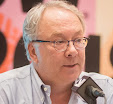
In New York recently I met Gayil Nalls, a multimedia artist who works with smell. She has a doctorate in the art and science of olfaction from the University of East London and more than two dozen solo exhibits to her credit. In World Sensorium, she asked every country in the world to identify its characteristic natural scent. She combined these into a fragrance in which each country’s scent is proportional to its fraction of the world’s population.
FN: How do you see yourself as an artist and how does smell fit into that picture?Nalls: My artistic practice engages conceptual questions around the human body and the attributes of crowds, our evolving understanding of the senses, and our relationship to disappearing ecologies. Materials and their symbolism are also very important to my work, as are their alchemic potential. By the mid-eighties I wanted to reimagine and authentically represent the world in a distinct way. For this, one sense was more valuable than the others - the sense of smell.
FN: Your major foray into smell is World Sensorium, a work that you refer to as a “social olfactory sculpture.” What I find especially appealing is how the concept connects people with place—the actual scents of real places. Tell us about this project.Nalls: It wasn’t until December 28th, 1989, when I was filming at the Berlin Wall, that the inspiration for the sculptural structure to create the world scent became vivid, fully formed in my mind. There were probably a million people on both sides of the Wall when the guards finally dropped their guns and freedom just flowed like an undammed river. In an unprecedented expansion of consciousness and human mass, one person after the other was pulled onto the top of the wall. Messages passed through the nerves of hands and my body and brain simultaneously understood that the formula would be based on population because everyone counts in this world. We are creating the form. By the next morning I knew that I would engage the world in dialog.
World Sensorium is about natural scents that work as olfactory imprints and memory triggers for large numbers of people of cultures in every region of the world. The components come together in a world formula based on country population percentages to the global whole. It took ten years to complete the work.
The work premiered as a public art in
Times Square 2000: The Global Celebration at the Crossroads of the World and was endorsed to the event by UNESCO. It rained down in microencapsulated paperworks with the confetti at midnight.
FN: What makes it a “world olfactory social sculpture”? Nalls: Several things. Foremost, it’s the information system that defines the world scent’s formula - where everyone is counted, and then it is world participation in the dialogue conducted over five years that helped establish the constituent ingredients.
World Sensorium is a social sculpture because it engages the world in a conversation about the sense of smell and about the concept of place and culture. The communication process is part of the form. The artwork links cultures in a unique and little understood way and makes the geographical experience of scent visible.
The term “social sculpture” was coined by the German artist Joseph Beuys who I met during his exhibition at the Guggenheim in 1979, and whose Socratic conversation I attended at Cooper Union. For Beuys, social sculpture was part of an interdependent democratic and ecological process.

Image on a microencapsulated sample of World Sensorium fragrance. © G. Nalls 2009
FN: Why the emphasis on natural smells?
Nalls: Our brains evolve in direct relationship to the molecules released in our environment. The botanical components of
World Sensorium are from the most important plants, trees, flowers, herbs and grasses that co-evolved with the human brain. Over centuries these became highly integrated into cultural practices because the physiological and behavioral responses were beneficial and desirable. Their volatile odorates are encoded.
World Sensorium is about the interrelated nature of the human brain, odor, memory, the natural environment, culture and the perception of beauty.
FN: Smell memory is a theme for many artists—how do you approach it?Nalls:
World Sensorium is about memory and how it equates to individual personality, societal culture and national identity. Without memory and this relationship to nature of place, we lose who we are. An early relationship with nature of place is a very real chemical relationship and without it we feel emptiness at the absence of something. It is felt in both the body and the mind: people have described it to me as a pervasive loneliness.
Many people cried with a thankful joy when they experienced
World Sensorium. They told me this was because the experience gave something back to them that they likened to the sense of well being they had when they were in their place of origin. They discovered that they had been mourning the loss of a chemical relationship.
FN: Why do you think World Sensorium had such a dramatic effect on some people?Nalls: Olfactory perception is complex and not completely understood yet, however, it is understood that smell mediates emotional behavior. In my judgment,
World Sensorium’s effect on people is due to the unique interactions of the olfactory brain’s neural circuitry that determine the affectiveness of an olfactory artwork and the level of significance that the aesthetic experience takes on.
In Olfactory Art, somatosensation equates to the perception of an aesthetic experience, which starts at the receptor level. Each odorant equates to an electrochemical signal felt or experienced. (This is where the perception of “the actual scents of real places” gets to the edge of science.)
World Sensorium, like all smells, is consciously perceived in the orbitofrontal cortex area of the brain, which is connected to the cortex, the reasoning area; the amygdala where the emotional connection is made and the behavioral response is activated; and the limbic system, also called the reptilian or primal brain, which is the area of automatic unconscious response.
Because of the sense of smell’s direct and nearly simultaneous neural connections, humans experience more powerful emotions from the sense of smell than our other senses. Science currently attributes emotional responses to associative psychology, but from what I have observed, it may also be possible that humans are hardwired to smell odors that are important to our survival. People with particularly important natural scent stimuli in their environment or heritage environment appear to be encoded to perceive them. A surprise for me was that people from different parts of the world feel both that they are responding to and can recognize specific odorants in the World Sensorium composition comprised of well over one hundred phytogenic materials. This may be important to the hypothesis that humanity’s sense of smell is made up of groups of people sharing different receptor families.

Portrait of Gayil Nalls by Joyce Tenneson
FN: Have you always been interested in smell or was this a creative singularity?
Nalls: I have always been interested in scent and the shades of it that we perceive or don’t perceive and what that means. As a child I was very aware of how atmospheric conditions affected my ability to perceive nature through my sense of smell, especially when heat and evaporating water were involved. Following scent trails was a big part of my play. Early on, I remember being very aware of how smells make me feel.
Smell has been critical to my artistic practice for the last twenty years. In addition to
World Sensorium, which is a work that will always be in progress, I have created other olfactory artworks, experiences, and olfactory sculptures based on information systems I create that reveal a truth or meaning. It’s about asking the right questions.
FN: What other olfactory artworks have you done? Nalls: In 1998, I created the installation
One Billion, Four Hundred Ninety-Five Million, Eight Hundred Fifty-Two Thousand, Twenty-Four (1,495,852,024) at Steffany Martz Gallery in Chelsea. The number represents the total population in the year 2000 of China, Pakistan, Algeria, Kenya, Saudi Arabia, Tunisia, Paraguay, Macau, and Djibouti, the countries for which jasmine is their most culturally significant scent. In the installation, the jasmine composition (formulated on the population percentages of the countries) of different species of jasmine was disseminated into the gallery space.
Also filling the space was my sound art piece of breathing in a 7:1 pattern, entitled
Breath, Essence, and (After)image, at a barely perceptible level. The auditory pattern enhanced the sensory awareness, serving as a cue to convey the message of experiencing an artwork through inhaling: that is, indexing the scent through the sound of breathing.
FN: Have you pursued the links between smell and the other senses?Nalls: In the exhibition
Synaesthesia at Siggraph Gallery held in Los Angeles in 2004, I was told I had created the Gallery’s first olfactory experience. I was working with a group called Plays Well With Others and we all created works for the OmniGlobe, a spherical projection system. In my work, a film projection titled
Hemispheres, I created an olfactory immersion environment around the globe. It was a eureka moment for me because I was able to successfully bring together film, sculpture and scent.
I think everyone has synaesthesia and like the acuity of sight, hearing, smell or intelligence, it varies with each person. Humans are hard-wired to continually obtain multiple sense impressions of the world. Without this, I couldn’t be making multi- and inter-disciplinary art. I just think that for most people, the cross communication between the senses is unconscious and for others nearly so, or greater. It’s all about the wiring. Just like you can have a supertaster or a nose, you can have a synesthete.
Based on art history and creators I have known, I think artists cultivate and refine a process, which for some, could be defined as a type of synaesthesia.
FN: Does technology ever play a role in your work? Nalls: At Siggraph in 2004 I exhibited
The Element Olfactory Works: Fire, Air, Earth & Water. The works were featured with the Morie Blue Tooth Scent Collar, a device originally created for virtual reality. The scents were released individually by remote signal as the model who wore it walked and posed on the runway during the Third Annual Cyber Fashion Show.
FN: Olfactory artwork is still relatively rare and unusual. What kind of response did World Sensorium bring you?Nalls: Experiencers of
World Sensorium celebrate what they harvest in relation to their ability to bring sustained attention to it. The longer people stay with
World Sensorium the more they sense its wide-ranging aesthetic experience and true character. It’s a great olfactory ride. For people who have a sustained experience of it, their response is frequently a Gestalt-like one: the experience culminates in a perception of the artwork as unified and harmonic. But ultimately there is no language for the expressive nature and power of the work, nor the knowledge it imparts about our connection with the world.
FN: Are people ready for scented art? Is the art world ready for it? What directions do you see as most promising and least promising?Nalls: I believe that people want to experience art that makes them feel, think, see and smell, differently. If they understand what it means to smell differently, they’ll think differently. Of course there is still a lot of denial and dismissiveness regarding the sense of smell by people in general, including artists. I have spoken with artists whose artworks were unintentionally very odorous and the odor helped shape the perception of the work, but because it was unintentional, they did not see it as part of the aesthetic of the work. Other artists have used scent to great advantage to convey very important and little understood truths about the human condition. When you ask if the art world is ready for it, I would say yes, but like any new genre, it will take some time before critics and curators have the ability to critique such works in a meaningful way.
A number of artists are working with natural smells of the human body and I find the work very insightful in the way it has challenged certain current cultural practices at the urging of commerce. These artists are pulling back the synthetic veil, pulling off the layers of olfactory artifice, to find the smells that allow for the deepest of human connections and delivering them back to us as art.
The advances in Olfactory Art provide new ideas and expanded understandings of the phenomena of smell beyond the creed of commerce and the limitations of science.
FN: You’ve told me that the average person is alienated from the sense of smell. What do you mean by that?Nalls: People, especially urbanites, now navigate their day through a maze of unnatural, artificial and synthetic aroma chemicals, polluting their bodies and coloring their perception of the world. We are on our way to even greater olfactory pretenses that will further undermine and manipulate the human condition.